hckrnws
We used OpenRocket for designing our rocket for UK youth rocketry competition UKROC[1].
It is great for getting a 'spherical cow in a vaccuum' idea of likely altitude with different motors, centre of pressure, center of mass etc. But it obviously doesn't take account of detailed aerodynamics etc and we found the maximum altitude estimates were about 15% too high. But it was still very useful.
[1] UKROC is an amazing competition for UK school kids. And there are equivalent competitions in the US, France and Japan, with an International competition for the 4 country winners. If you know any kids interested in engineering I recommend you look into it.
> we found the maximum altitude estimates were about 15% too high.
this often happens when the wrong rocket finish is selected. Everyone chooses a polished finish when in actuality they've just sprayed the thing with paint.
Skin drag is real.
Possibly. I don't remember the details. Also, it isn't a full aerodynamic simulation. Plus the hobby motors are not manufactured to NASA standards. So you can't expect it to be too accurate.
They also seem to be treating rockets as rigid bodies. Flex of parts is real at these accelerations but the calculations get into supercomputer territory very quickly. All the math is questionable if, at any given moment, your rocket isnt actually straight.
Look into the physics of archery, which has similar accellerations albeit of a narrower tube. The choice between a heavier/stronger arrow v a lighter/flexible shaft is the entire game.
If your rocket is flexing significantly, then it probably won't be a rocket for very long!
Heh, UK tinkerer here :)
How hard is it to get started for amateurs? Are rules/regulations problematic?
Not hard. Buy an Estes kit. Go along to one of the regional meetings, fly your rocket and talk to people there - they are very friendly.
The UK regulations are fairly sensible and they won't let you do anything stupid at one the regional meets. Just start with something small (A/B/C motor) and work your way up from there. Don't try to start with a K motor, 2 stage or liquid propellant and you'll be fine.
Where are you based?
Thanks, I'm in NE Scotland.
I can't find the French competition, ironic given that the front page of ukroc is full of French gov officials... Could you share the name if you have it?
The biggest one is C'space: https://cnes-edu-cspace.com/cspace-2025-en/
There is also the European Rocketry Challenge in Portugal: https://euroc.pt/
And for older students in the UK there's https://race2space.org.uk/
uau uau uau uau… uau
obrigado!
The French and Japanese competitions seems to be rather low-key compared to the UK and US competitions. The winner of the French schools is mentioned here:
https://www.safran-group.com/news/have-you-heard-about-rocke...
Maybe you can contact the school and find out more?
This application gets used a lot in the High Power Rocketry hobby. Most of the parts/manufactures are included as well as motor manufactures. The simulations are very good and accurate, I would sim my larger builds at the location where i was launching to get an idea of altitude and it was always pretty close ( within 5-10% i'd say ).
I use to have a website where you could upload an openrocket file and get back 2d drawings for your fins that could then be sent to my lasercutting service. The idea was design the rocket in openrocket, send me the file, and get back the wooden pieces you need cut per the design. Similar to sendcutsend but for the rocketry hobby.
Really cool seeing it show up on HN.
Software developers: I am begging you to put representative screenshots on the home page. This has become a real widespread problem.
I know you want to tell us all about the amazing (sincerely!) stuff under the hood, but to users, the interface is the product.
Thanks for the suggestion, I've added it to our home page.
This is one of my favorite things about HN.
I'm into rockets, and clicked the link earlier today. I shared the suggestor's view, but didn't bother to post. I came back now, saw the comment thread had updated significantly, noticed that OP had addressed the suggestion, clicked again -- and noticed, hey wow, there are cool screenshots now, these are a lot more interesting, this is better than I thought!
Nice, that actually looks really good. I was not expecting that.
Usually when there's no screenshot or video for GUI apps I assume it's because the creator is not proud of it, so a sign that the UI will be shit.
We spend a lot of effort on our UI and UX. I dare to say it's one of OpenRocket's defining features. There's still much work to be done though.
The screenshots looks great, definitely helps someone unfamiliar like me get a feel for what to expect.
That is a big improvement.
A short looping video of the software in action might also be good. But a lot more effort.
Nice, it's much more clear to a layman like me! (Not the gp)
[dead]
I also like it when there's a short video that shows how the thing works and what it can do.
I can't believe how common this is now, if you dont have screenshots AND a video you are shooting yourself in the foot.
If anyone is curious of what I expect (in page order top to bottom)
Screenshot of complete product ui with description (showing complete UI)
Button to the download/buy product.
Header/tagline description of feature below:
Screenshot of individual parts of the UI (These are more often then not videos these days/gifs). Description of these screenshots
Buttons to expand to another page to learn more.
Bluntly, Just copy what other companies are doing. They are doing it because it works.
Example
Here's how this page looks on my phone:
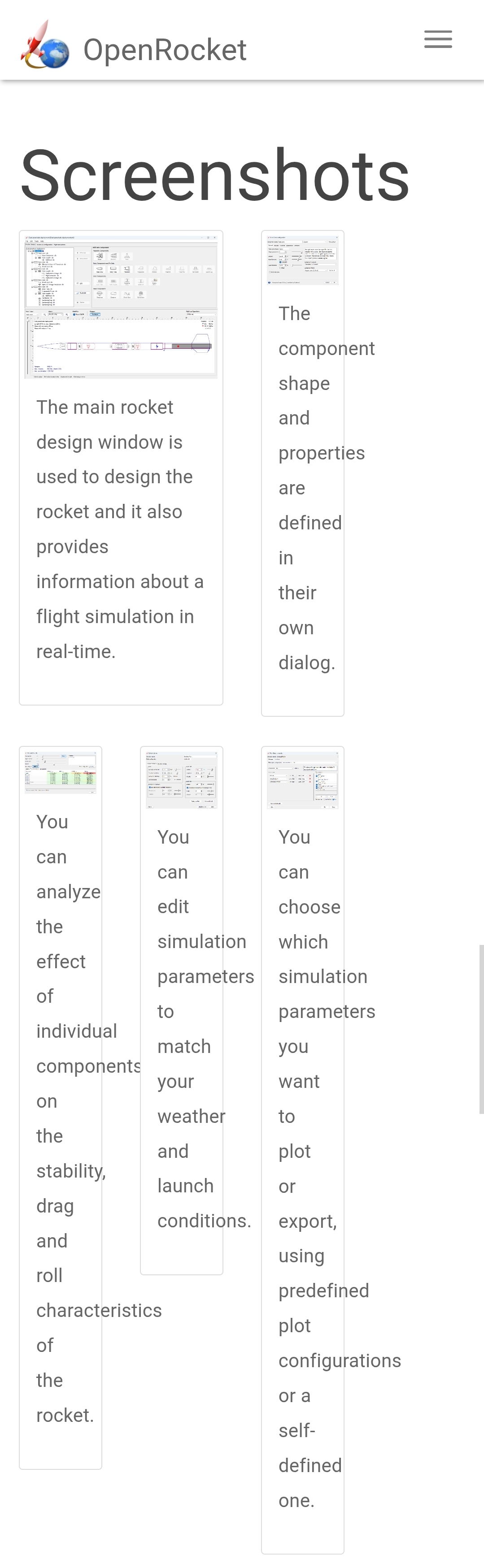
I said
> on the home page
and I meant it
Yes!!
Sadly they don't teach Show Don't Tell in the lectures
Tangentially related is NASA's open source GMAT[0] software which is more focused for calculating orbital transfers and the like. It's pretty fun to play around in.
This is pretty cool. I remember having fun simulating my rockets using the BASIC programs from G. Harry Stine's "Handbook of Model Rocketry" when I was a kid. This looks like a way to recreate some of that fun.
There is also the rocketpy framework. https://docs.rocketpy.org/en/latest/index.html
Essentially it can do the same thing as openrocket, but in python. You can even go as far as to simulate liquid fueled rockets during flight, modeling for example how the depleting tank influences the center of mass. My student rocketry team used this for the flight simulation of our Ethanol/Liquid Oxygen rocket which flew to over 5km
>My student rocketry team used this for the flight simulation of our Ethanol/Liquid Oxygen rocket which flew to over 5km
Cool. Is there more information on their rocket or a video?
Sure! We launched at last years EuRoC Here’s a nice recap video: https://youtu.be/pc_Dvfo6m0g
Also here is our technical report: https://spaceteam.at/wp-content/uploads/2025/10/Technical_Re...
Feel free to ask any questions. I’m the software lead of the project :)
Impressive. Where was the launch from?
Well THAT's cool. I was just talking about getting back into model rocketry... I'm not sure my 6yo daughter will like it as much as I did/do but I want to get back into it and launch a few and see if she's into it. Timing here is great as I need to start looking at starting from scratch with kits etc.
I bought my son a Estes kit about 10 years ago. He's now at University studying aerospace engineering as a direct result. So you never know!
Our university rocket team uses openrocket extensively for doing fast design iterations early in the design phase. We have also used Rasaero II which is meant to be more rigorous above transonic speeds. We have an Ansys CFD too but that requires significantly more time to set up. We still use openrocket on launch days to do pre launch sims, but we override some of the parameters based on the more rigorous simulations.
I would recommend checking out your local laws on export of software with military applications. I believe this would be illegal to release in my country (whether that's the right thing is worth discussing, but protect yourself first).
Looks like a pretty mature project though so I suppose it must be on solid ground.
It might also run the risk of breaking IMPORT laws in your respective countries, worth being sure of because that is not a realm of law you want to be messing with.
I read the name and the first logical thought that came to mind was that of a platform to have AI agents iterating on rockets design. How doomed am I?
Just reading the name I wouldn't have been surprised if it had nothing to do with rockets whatsoever - I was half expecting it to be some kind of "agentic platform to accelerate your product development" etc.
I think I need to go for a walk.
That was also my first thought...... :D
Generative AI iterating on design is being done with satellites in production already (and given that there's limited scope for real world testing so you're solving complex optimization problems against a set of models, actually represents one of the better use cases for generative design). Don't think the foundation models and physics based constraints solvers involved look much like LLM "agents", mind you..
OpenRocket has a little optimizer built in but of course it neglects structural integrity which it knows nothing of…
Why would you put that evil thought into other people's heads? Now someone might do that
I figured it was a typical no-info HN title; I was happy to discover it actually conveyed some meaning.
I wonder how crazy the scale here can get. How far can I go? The bps.space guy is heading into space. Can the community hit the moon? Literally.
Amateurs have reached the karman line, orbit is still pretty much out of reach. The people who get close to the karman line use two stage passive stabilized airframes and solid fuel motors. The airframes are basically works of art and it takes a lot of luck because of passive stabilization and Mach 3+ speeds. Many pictures of these rockets have their paint and leading fin edges burned off when they're recovered. Propellent is expensive and an attempt at > 100k feet is about $5-6k an attempt in propellent alone.
This guy is widely respected in the hobby and this flight made it to 293k feet https://www.youtube.com/watch?v=gmv7G6Rf5WE
Check out the liquid bi-prop engines the halfcat guys have, apparently they were just certified by the HPR hobby governing organization Tripoli which means they can be insured at sponsored launches. With a liquid fueled engine you can do thrust vectoring (nozzle gymbaling) easier than solid fuel motors so active stabilization is more feasible. If you have active stabilization then all you need is thrust to weight > 1, enough fuel, and you'll eventually get to whatever altitude you want. Orbit means orbital velocity and that's just a whole other ball game.
> 293k feet
89 kilometers
Space Concordia, a Canadian university space-oriented student group, which is sort of amateur-level given that it’s driven by students and donations, attempted to reach space not that long ago with a liquid fueled single staged rocket. Here is a video of the launch https://www.youtube.com/live/610YciEs8qg?t=4594&is=aAWo8Y7vi...
Thank you so much for sharing this video, it's just amazing to see a bunch of young amateurs getting so excited about things that would have been virtually inaccessible 20 years ago.
It’s beautiful to see. They have put in such extreme amounts of hard work to get that thing into the air. Designing a robust affordable liquid propelled rocket from scratch is hard. There are so many design decisions, complex simulations, manufacturing difficulties, and tests for every little part of that 11+ m rocket. Accounting for extreme forces, heat variations, vibrations, wind, atmosphere, liquid sloshing, rotation, etc during ascent and descent. It’s not only mechanical/aviation engineering but also software, electrical, sourcing donations, documenting everything in forms of design and risk assessment reports etc etc.
You also have to try to account for every little possible failure mode before launching which is why rockets seldom succeed on the first attempt.
And then dealing with authorities to create new launch sites and permits which probably hasn’t been done in decades in Canada.
Indeed, there are so many different ways a rocket a fail. Launch rail buttons detach, motor chuffs, motor explodes, fin falls off, structural failure (banana), parachute doesn't fire, parachute doesn't deploy, parachute detaches - to name just a few.
Might be worth checking out the "Copenhagen Suborbitals" group (they have a YouTube channel) and see if they're still active! It's been years but I think I recall they were trying to build something capable of getting a person into space (not sure if orbit was a goal).
"Space" is 100km. The moon at its closest is about 350,000km.
So the jump from the former to the latter is... significant.
Distance is usually the wrong measure in space. Something like delta-v will give you a much better scaling as once you manage to get something to orbit the rest is actually a lot closer than it would seem on the ground.
Not to say the effort somehow becomes peanuts, cheap, or easy... but the jump in delta-v needed to go from "100 km vertical ascent" to "hit the moon 350,000 km away" is more like a ~6-7x increase than a 3,500x one. If the moon were instead 700,000 km away the factor would still be ~6-7x.
Cool site for delta-v estimates https://deltavmap.github.io/
Everything you've said is correct, but Delta-V scales logarithmicly with fuel load - you need to carry the new fuel. So for purpose of discussing altitude (a valid way to look at getting to the moon) the size of the rocket, and the fuel expended, does in fact grow much closer to linearly.
I think I'll go land on Mun and Minmus now...
What I actually started with was comparing Electron to the current bos.space rocket and seeing the relationship was nowhere near linear. The above is the largest component of why I could think of but there is always more than 1 thing going in.
Wow even as a bit of a rocket nerd i'd never thought about it that way, that's pretty cool!
And you need a serious amount of money, effort and expertise to each 100km with a rocket.
Amateur rocketry achieving orbit would be significant. Reaching the moon would be substantially more difficult.
Oh i've been looking for a project for my 11 year old... he's a very project oriented learner, which schools don't seem to do anymore.
What country are you in?
Im guessing that all the sudden interest in rocketry and drones is related to the war in the middle east? Because I have found that very interesting too, that a country as poor and as heavily sanctioned as Iran is managing to hold out the mightiest human forces the world has ever seen.
Only someone coming out of the US education system can have both the power to start such a war and the complete lack of knowledge needed to think it would go well...
> a country as poor and as heavily sanctioned as Iran
It's one of the oldest civilization in the world
It's not poor by any means, it's the 20th economy in the world
They produce as many engineers per year as the US, and they're not financial engineers or saas coders, fyi:
> mid-14c. enginour, "constructor of military engines," from Old French engigneor "engineer, architect, maker of war-engines; schemer"
Sanctioned for half a century means they developed other ways to live and survive
Model rocketry has long been a gateway drug to get kids interested in STEM subjects.
Helps to have terrain around your country that makes it one giant fort
What do they hold, exactly? Leaders are dead and keeps dying, good chunk of their military is defunkt, while "mightiest human forces" don't even have boots on ground.
I highly recommend you to open a few foreign newspapers and lurk in foreign forums, groups, &c. you're either misinformed or blind
> don't even have boots on ground
Anyone with half a brain cell knows this would be the biggest strategic, tactical and political blunder of the century
> What do they hold, exactly?
What they hold exactly is:
- middle eastern countries who've been greasing Washington's palms for influence and protection received 0 protection, it'll take decades to rebuild any trust here
- Americans deserted their bases in the region instantly, they are now damaged or destroyed, the US conveniently ask satellite image providers to delay the release of new data
- Lost a bunch (most?) of radars from their early warning system in the region
- US sailors seemingly set their own ship on fire to avoid deployment
- Depleted israel interceptor stocks, more and more things are passing through the dome
- the US spent 12b so far to fuck up Iran, Russia made 6b from the gas price increase in the meantime, big brain move
- the US pulling out of asia to send more shit to the middle east, eroding trust of countries like South Korea
- Israel support in the US is falling fast, in the EU it's gone
- the price of everything will slowly rise, because everything we use rely on gas one way or another, they've been sanctioned for 50 years they don't give a shit anymore.
- the US showing their complete lack of strategical vision, saying something on monday, the opposite on tuesday and denying they even said either things by wednesday
No, _I_ highly recommend you to open a few foreign newspapers and lurk in foreign (to whom?) forums, groups, &c. you're either misinformed or blind, based on these bullet points.
Stop reading r/iran or CNN or whatever bs you pump into your brain.
This war sucks but it's very far from "Iran is holding".
They're getting absolutely wrecked, but it doesn't mean it's good for the US. This is basically warfare 101, you can have a undisputed tactical victory and a complete strategic failure at the exact same time, in that case the tactical victory is bombing a country which is like 20 years behind in technology and spend 10% as much as the US on defense (wow good job!), the strategical blunder is that it did not achieve anything good for the short nor long term for anyone involved, if anything it helped Russia and China which kept being mentioned as the US arch enemies
Iranians don't like their current government much but they don't particularly like getting fucked up by Israel and the US either, especially when you kill 170 kids on day 1 and then lie about it on live tv. How did it go in Syria, Libya, Afghanistan, Iraq? Yeah, not so good. It's always about "preventing wars" and "bringing freedom", but it ends up being "bringing wars" and "consolidating authoritarian regimes"
Time will tell.
The strait of hormuz is still closed, and a new government has not been installed.
From a conventional perspective Iran is by all means "losing" the war. However, the United States and the majority of the world desperately want the strait to be opened and have so far been unsuccessful in preventing Iran from blocking it. The US is also greatly interested in regime change, which has also been unsuccessful.
> The US is also greatly interested in regime change
Trump doesn't car about regime change. Just like in Venezuela, his plan is to kill leaders until there's one that can make a "deal" (whatever it means).
Agree with what others have said. And will add that under Trump US was losing soft power around the world. But attacking Iran accelerated that process significantly.
Most of our allies feel that they can give us the middle finger when we ask for help. More people around the world than ever before now think that US and Israel are the biggest threat to world peace.
This is new and uncharted territory for us. We will pay a bigger price for this over the coming years and decades than whatever we did to Iran.
Does anyone know of something similar, but for aircraft and/or drones? I’ve been 3D printing model aircraft with my 8-year old but would be great to take it to the next level.
[Ardupilot|https://ardupilot.org/] maybe? It's for controlling the drones, but I think it has simulators as well.
https://flow5.tech/flow5.html gives you the lift/drag/moment curves, and stability coefficients from a (simple) 3D model
There is a game on Steam where you can design and fly your own aircraft. Would be fun to then try to 3d print the successful ones. But I can't remember the name of the game, sorry.
Kerbal Space Program?
Homeworld
No, its more aircraft oriented.
I think it was:
The miracle of 3D printing. First ghost guns, and now ghost rockets. Will be curious to see what prediction markets will have for these.
you get some good, you get some bad.
Building a rocket shell is probably just fine: you need to fuel yet - that you can't 3D print. probably fine...
Overall 3d printing is a lot more than ghost guns and ghost rockets. That the conversation dominates this small sub-section reeks of 'think-of-the-children' screeching that hides explicit power grabs in regulation and surveillance with the main intent seemingly to be 'enforce copywrite' (of only the big players that can afford to throw their weight around).
Fear pushes people's buttons.
Frankly, if enforcement was half as effective as the dystopian crowd claims, nobody would be torrenting movies or running Pi-hole on their home net today.
i've recently had youtube randomly suggest me a video where this dude was building his own opensource manpads, with a single rocket costing under $100 in parts (there was no explosive payload so that makes it just a rocket and not a missile, i guess). not long after, someone posted it here on hn but i think it's been removed (by the mods, i imagine) since.
i find these projects both fascinating and terrifying. seeing a single person building what normally involves huge defense corporations and government contracts, these things in their bedroom is amazing. it shows how information wants to be free and how ingenious people can get with whatever motivates them.
> someone posted it here on hn but i think it's been removed (by the mods, i imagine) since.
The submission: https://news.ycombinator.com/item?id=47425297 "Tech hobbyist makes shoulder-mounted guided missile prototype with $96 in parts" - https://github.com/novatic14/MANPADS-System-Launcher-and-Roc...
Seems to have almost as many comments as points, so guessing it got pushed down the frontpage list because of the "anti-flame-war" thingy HN has.
The knowledge and skill in the HPR (high power rocketry) hobby is definitely there to build basic weapon systems. Active stabilization using movable fins is a thing, onboard gps and flight controllers are also a thing. Nobody puts it together end to end though because it gives the whole hobby a bad look and the hobby governing organizations strongly discourage it too. Also, fortunately, most people have no interest in mass murder either. Much of the hobby is old engineers who are retired but still want to work on engineering projects in their garage.
It was here on HN (441 points)
> with a single rocket costing under $100 in parts
Is there a parts list?
I believe it is the same project that was discussed here a few days ago: https://news.ycombinator.com/item?id=47385935
I know; I thought they'd have a handy parts list on their new site. But you are right; I should have looked in their Google Drive docs. There's a section - "Bill of materials and cost breakdown", but details are buried somewhere. Thanks, though.
Need itar to be defanged first.
I helped out with a user interface redesign of OR many years ago. It was pretty incredibly unintuitive back then, and many hobby rocketeers paid for Rocksim instead.
With CAE and flight simulation, this would be a game that I would actually enjoy playing.
What about misuse for weapon development? Does the project not massively cut R&D costs (hence lowering the entry hurdle) for potentially malicious actors on the planet?
Sure, but it's not like the actors currently able to pass the entry hurdle are not malicious.
Maybe we (or somebody in, say Ukraine or Rojava) will need this to defend themselves from the actors having access to missiles right now.
No, actually building the things are most of the work and this program isn't intended for weapons development so you will just save a few tests at most, so it helps marginally.
Anything can be misused by the bad actor. Knives, guns. With AI things are getting easier to develop bio-chemical weapons. There was recently a video of a YouTuber creating a portable rocket launcher in <100 USD.
Even if it does, you need industry to have any meaningful impact. And a big army with distributed attack nodes.
With the current wars this will only gain more interest.
But hopefully not that kind of interest.
Model rocketry, as a hobby, enjoys a limited amount of regulation, at least in the US. In large part, that is because the community has been very good about self-policing. Most folks who are serious about the hobby closely follow the safety guidelines published by the two national organizations (Tripoli and NAR), and steer newcomers to as well. Serious accidents are few and far between, intentional damage even more so. Compare this to, say, drones, which seem to be more widely embraced by the public, but are much more closely regulated and have been implicated in a number of serious incidents like https://abcnews.com/US/drone-operator-charged-hitting-super-... . Model and amateur rockets are cool. Folks mis-using them are going to run into a lot of pushback from pretty much every direction, because it'd only take an incident or two to ruin the hobby for everyone.
similar situation in the UK. It would only take 1 or 2 idiots to ruin it for everyone.
Hobby rockets fall into the same regulations as drones.
Not true in the US either, in any meaningful way. Weight thresholds are different, FAA thresholds are different, allowed control systems are different, etc., etc.
Not in the UK (may be true in other countries).
Love to play "Useful program or random startup" with these titles.
I hope this is for students' project and for sending a gopro to the stratosphere?
There should be an agent for this :D . What kind of tooling do you folks use for simulation ? Maybe there is something to be done there. ?
or an integration with a 3D game engine
Hahah - you'd have made Kerbal Space Program :-)
Is there a similar drone design simulator?
idk off hand but i'm sure there's something like OpenRocket for R/C airplanes. Where you put in the dimensions, wing type, mass distribution, and other stuff and it tells you if it's aerodynamically stable or not. After that you put in an ardupilot autopilot+gps+airspeed sensor and there's your drone. iirc, with ardupilot you can do automated flight planning like "fly to this gps coordinate, orbit for 10 minutes, fly home" etc.
to relate to OpenRocket, some people are into rocket powered gliders and use autopilots to make flying them after launch easier. It's basically a fly by wire setup so controlling the glider is on easy-mode with the autopilot doing most of the work keeping things stable while the human with the controller just focuses on making the slow circles back to the launch area. These autopilots are how typical quadcopter drones can be flown easily without the wind and 4 motors causing havoc constantly.
You describe https://flow5.tech/flow5.html (Im not directly familiar, but it is an extension of xflr5 which I have used). Gives you the lift/drag/moment curves, and stability coefficients of a fixed wing drone/rc airplane
Have you seen https://store.steampowered.com/app/2060160/The_Farmer_Was_Re...? It is not a drone simulator more like a problem solving game using a drone.
Its a nice project !
you gonna need them!
[dead]
Bookmarked :)
Crafted by Rajat
Source Code